'%3e%3crect%20x='5'%20y='5'%20width='16'%20height='16'%20rx='3.6'%20fill='%23151A21'/%3e%3crect%20x='43'%20y='5'%20width='16'%20height='16'%20rx='3.6'%20fill='%23151A21'/%3e%3crect%20x='5'%20y='43'%20width='16'%20height='16'%20rx='3.6'%20fill='%23151A21'/%3e%3crect%20x='43'%20y='43'%20width='16'%20height='16'%20rx='3.6'%20fill='%23151A21'/%3e%3crect%20x='24'%20y='24'%20width='16'%20height='16'%20rx='3.6'%20fill='%23FF5A1F'/%3e%3c/g%3e%3c/svg%3e)
A packing robot for the station with the highest churn.
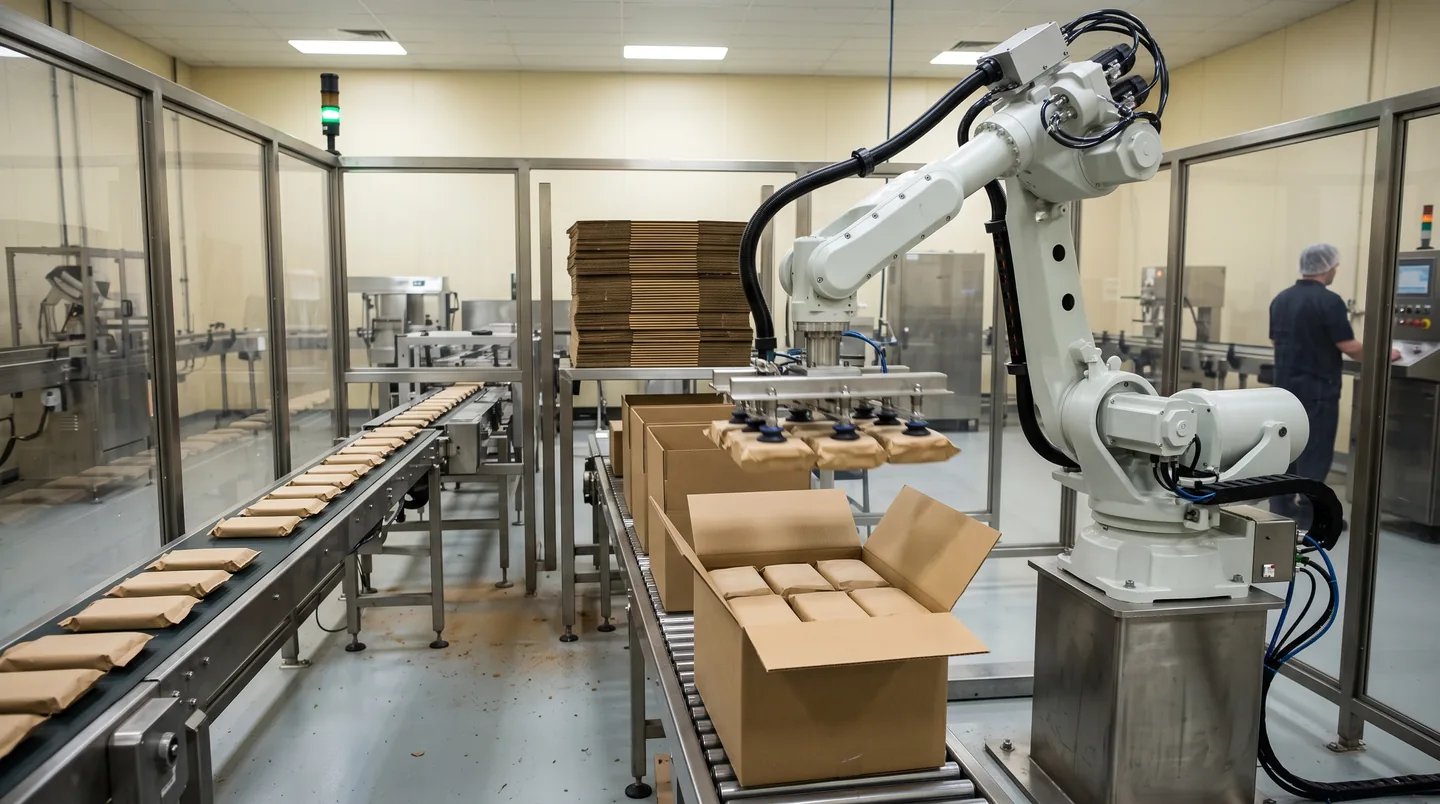
Arrange the product, place it in the carton and leave it ready to close: repetitive standing work at the pace of production. It is usually the station with the highest churn. Robotized, it stops depending on how many people showed up that day.
Packing stations
Arranging and boxing at the end of the line: ordering the product, placing it in the carton and leaving it ready to close. It is repetitive standing work paced by production, and it is usually the station with the highest churn. Robotized, the station stops depending on how many people showed up that day.
- What we measure: cartons per hour, units per carton and packing pattern.
- Where it shows up: end of line in food, beverage and consumer goods.
- Typical equipment: medium-payload arm with a multi-part end effector.
- A good sign: few carton formats and a defined packing pattern.
- Logtix monitoring included in the fee: the cell is watched from our control centre.
When a robotic packing station fits
These are the signals we measure during the technical visit. If your operation ticks most of them, the task probably fits.
-
Few carton formats
Defined formats that change by recipe. Unpredictable casing is still people's work.
-
A defined packing pattern
How many units per carton and in what order. If the pattern exists, it can be programmed; if it changes daily, it does not fit.
-
Paced by the line
Constant cartons per hour at the end of the line: the pace that is hardest to cover with high churn.
-
Where it shows up
End of line in food, beverage and consumer goods, usually next to palletizing.