'%3e%3crect%20x='5'%20y='5'%20width='16'%20height='16'%20rx='3.6'%20fill='%23151A21'/%3e%3crect%20x='43'%20y='5'%20width='16'%20height='16'%20rx='3.6'%20fill='%23151A21'/%3e%3crect%20x='5'%20y='43'%20width='16'%20height='16'%20rx='3.6'%20fill='%23151A21'/%3e%3crect%20x='43'%20y='43'%20width='16'%20height='16'%20rx='3.6'%20fill='%23151A21'/%3e%3crect%20x='24'%20y='24'%20width='16'%20height='16'%20rx='3.6'%20fill='%23FF5A1F'/%3e%3c/g%3e%3c/svg%3e)
A pick & place robot at the pace of your conveyor.
Pick a part and place it somewhere else, thousands of times per shift. The problem is not weight — it is holding the rhythm for eight hours without errors. That is where a person wears out and a robot is only getting started.
In-line pick & place
Take a part from one point and place it at another, thousands of times per shift, at the pace of the conveyor. It shows up on food, plastics and pharma lines. The problem here is not weight — it is consistency. A person can hold the rhythm for an hour; holding it for eight, shift after shift, is where errors and absenteeism appear.
- What we measure: parts per minute, travel distance and positional tolerance.
- Typical sectors: food, plastics and pharmaceuticals.
- Typical equipment: a fast, light-payload arm — or a collaborative robot (cobot) when the pace allows — with a vacuum cup or custom gripper.
- A good sign: consistent product shape and a repeatable infeed position.
- Logtix monitoring included in the fee: the cell is watched from our control centre.
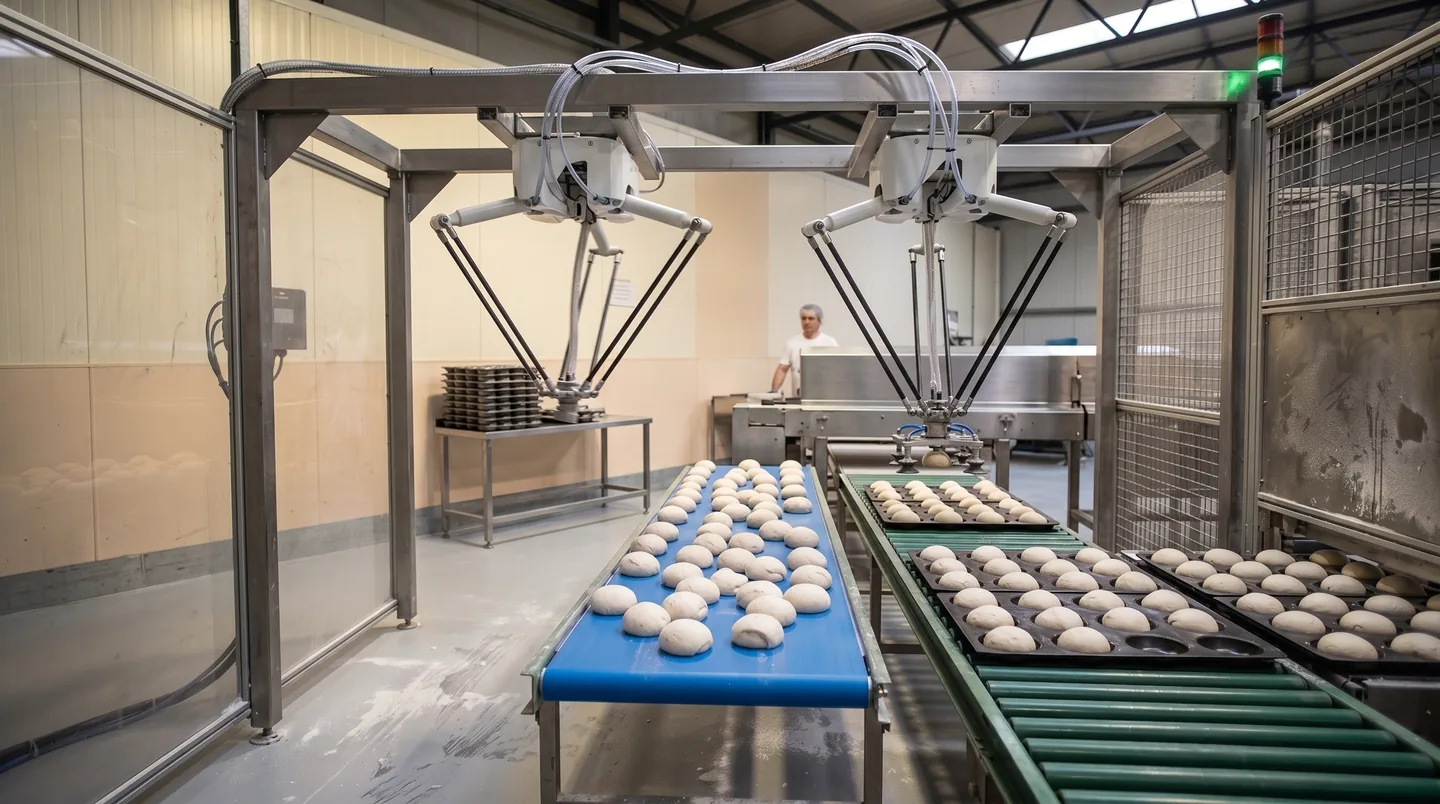
When a pick & place robot fits
These are the signals we measure during the technical visit. If your operation ticks most of them, the task probably fits.
-
Consistent product shape
The end effector is designed for your product: vacuum cup, custom gripper or multi-part tool. The shape has to be predictable.
-
A repeatable infeed position
The robot picks where it expects to find. A guided conveyor or an infeed nest solves most cases.
-
Sustained rate, not spikes
Constant parts per minute across the whole shift: exactly what is hardest for a person to sustain.
-
Sectors where it already runs
Food, plastics and pharma: lines with uniform product paced by the conveyor.